Tisch Library's "Affordable Course Materials Profiles" feature interviews with faculty & instructors who have received an Affordable Course Materials Award.
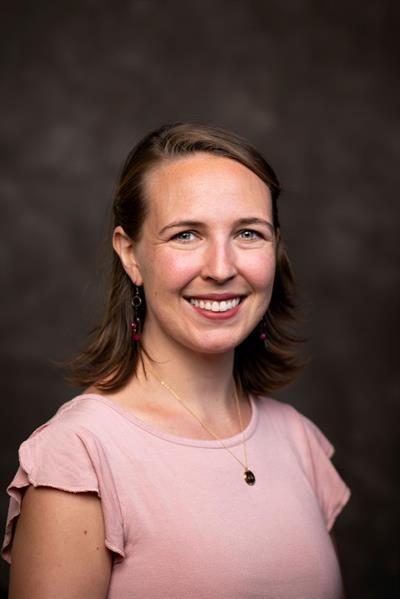
This interview is with Professor Lauren Crowe, Associate Teaching Professor in the Department of Biology. Professor Crowe received an award for Fall 2025.
What department do you teach in? Which classes do you most commonly teach?
I teach and coordinate several courses and programs in the Biology Department. I teach Bio 13: Cells and Organisms (one of the introductory Biology courses) and a mid-level Cell Biology course (Bio 46). I also coordinate our research-for-credit program (Bio 93 and Bio 193) and co-facilitate our year-long Civic Biology Fellowship with Dr. Jonathan Garlick!
Briefly describe your project to use or create more affordable course materials for students. What motivated you to use these new materials?
Intro Bio texts are big, bulky, and costly. Textbooks can be great – they have all the information you need consolidated into one place! However, sometimes students don’t learn the best through reading, or maybe need to see videos/other explanations of content for something to really click. I wanted to create an alternative/supplemental course materials guide (ACM guide) for Bio 13 students that could be used by both students who use the textbook and students who choose not to use the textbook but still want to make sure they’re getting reliable information that is relevant to the course. It’s an easily navigable one-stop-shop for supplemental videos and tutorials, linked to course readings and topics. I hope that this makes access to the course content more accessible and equitable!
How were students impacted by the new materials? What was their reaction?
The ACM guide was used by nearly half of the class (258/538 responses, 48%), either standalone (21.5% of responses), with a personal copy of the book (24.3% of responses), or with a copy of the book on reserve at the library (2% of responses). Nearly 75% of the class continued using the textbook in some way, but of those 35% also used the ACM guide. Still awaiting the final verdict, but based on usage alone, many students benefited from using the ACM guide either as a supplemental guide or as alternates to the reading assignments.
What was your experience incorporating these new materials into your course? How did the Tisch award support your work? Were there challenges?
The application was straight forward, and although I wasn’t sure what format I wanted the guide to be in, this idea had been building for a while with no bandwidth to support it. Being able to develop it over the summer gave me the flexibility to take my time with it, and to see it used so widely in the class has been incredibly rewarding!
Do you have any advice for other faculty considering a switch to open and affordable course content?
Affordable course materials doesn’t have to mean totally switching to an OER textbook, or designing all of your own course materials. My approach allowed me to change my required textbook to recommended, because although I still think the textbook is the most straightforward approach to some of the out-of-class work, there ARE resources available and students sometimes need guidance on finding reliable sources that meet the same level covered in class.